Marius Brînzea: “Lobby vs. Lobby: Why Noise Won’t Change PPWR and What Companies Should Do Before August 12, 2026”
Inspired by the analysis published by Marius Brînzea, Strategy Director at Reciclad’OR, on LinkedIn and republished by Revista Piața. An analysis of the initiative to postpone PPWR and the clear message conveyed by Marius Brînzea: the PPWR regulation will not be postponed, responsibility remains.
A weekend, 460 logos, and a question that stirred the market: is PPWR being postponed?
In recent days, the business environment has been surprised by a “mobilization initiative” that appeared on LinkedIn, requesting the postponement of the application of the European Regulation on packaging and packaging waste (PPWR).
The post, built in an emotional register and using viralization techniques, generated real confusion among some companies: “Is PPWR really being postponed?”
Starting from these questions, Marius Brînzea, Strategy Director at Reciclad’OR, published a firm and lucid analysis of the situation — an analysis that was later republished by Revista Piața.
His central message is clear: no, PPWR is not being postponed, and the noise created around this initiative does not change the legal and institutional reality of the regulation.
1. The European Commission has already said “no” — several times
In his article, Marius reminds us of an essential fact: the European Commission has repeatedly rejected requests for postponement, including in October 2025, when it explicitly confirmed that August 12, 2026 remains the enforcement date.
Neither political pressure nor informal campaigns have changed this position.
2. “The single voice of the industry”? A false claim
The LinkedIn initiative claims to represent “the European business community.”
Marius’s analysis quickly dismantles this claim:
None of the major European or global professional associations are among the signatories.
The list of logos does not reflect the position of the industry, but only the position of one camp — especially players in the single-use packaging sector.
In a regulated ecosystem such as the EU, professional associations, sector federations, and chambers of commerce are the ones that officially represent the interests of the industry, not spontaneous weekend lists.
3. Mobilization techniques, not public policy arguments
Marius draws attention to elements that belong more to marketing than to regulation:
spectacular numbers (“460 companies in one weekend”),
emojis and emotional wording,
trap questions,
the call to send the company’s logo.
These are tools of social pressure, not technical or legal arguments.
A logo is not an impact assessment.
4. The real concern exists — but it does not justify the confusion
Marius acknowledges a sensitive point: the mid–fiscal year transition is a real challenge for many companies.
But this challenge does not justify:
spreading misleading messages,
creating a false impression of consensus,
fueling the hope of an unlikely postponement.
5. Strategic recommendation for companies: do not wait for a postponement
The key message of the analysis is pragmatic and responsible:
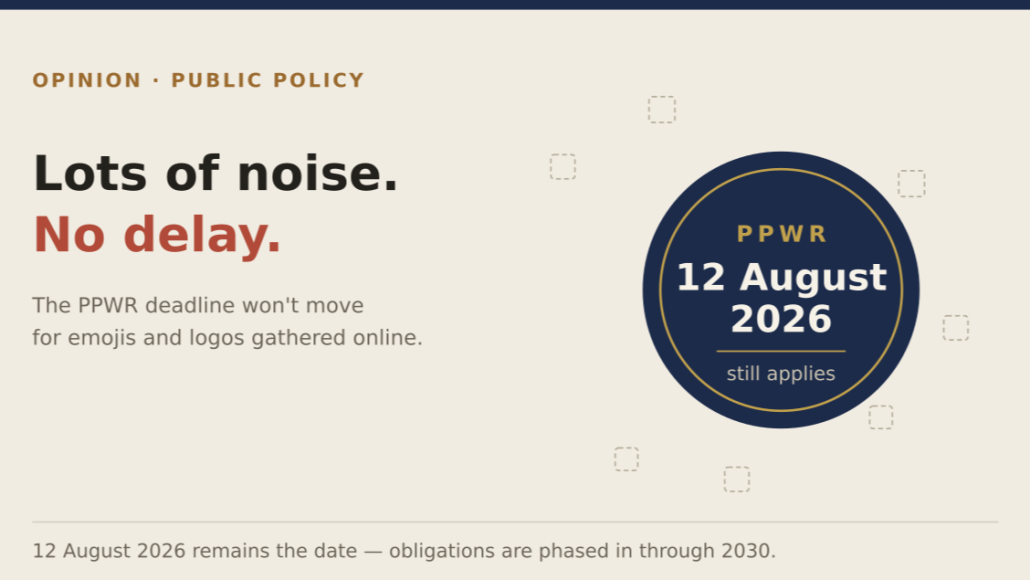
“At the current level, August 12, 2026 remains the valid date for PPWR. Check exactly which obligations actually affect you and when.”
Companies must focus on:
identifying the obligations applicable in 2026, 2027, 2028 and up to 2030,
adjusting their packaging portfolio,
preparing documentation and traceability,
collaborating with their partner OIREP for implementation.
Not on signing appeals that have no institutional force.
6. A question that remains open
At the end of his article, Marius raises a profound question:
If a list of logos gathered over a weekend could postpone PPWR, what would that say about the entire regulatory mechanism of the European Union?
It is a reflection that goes beyond the specific subject of PPWR and touches on the broader theme of institutional resilience.
Conclusion: between noise and responsibility, companies need clarity
Marius Brînzea’s analysis brings exactly this clarity:
PPWR is not being postponed.
The obligations remain.
Preparation must be accelerated, not delayed.
In a context where information circulates quickly and is sometimes distorted, our role — as a responsible organization in the circular economy — is to offer companies real data, correct interpretations, and strategic direction.
The voice that matters
More than 1,200 companies have not chosen the same OIREP by chance.
Reciclad’OR — the voice that matters when responsibility also means results.
Because we believe sustainability is not done out of obligation. It is done out of vision.
Reciclad’OR is one of the most important OIREP organizations in Romania, with expertise in responsibility transfer, collection and recycling, environmental consulting, and circular economy.
If you are a producer, importer, or retailer and want to understand how to efficiently meet your recycling responsibilities, we are here!