
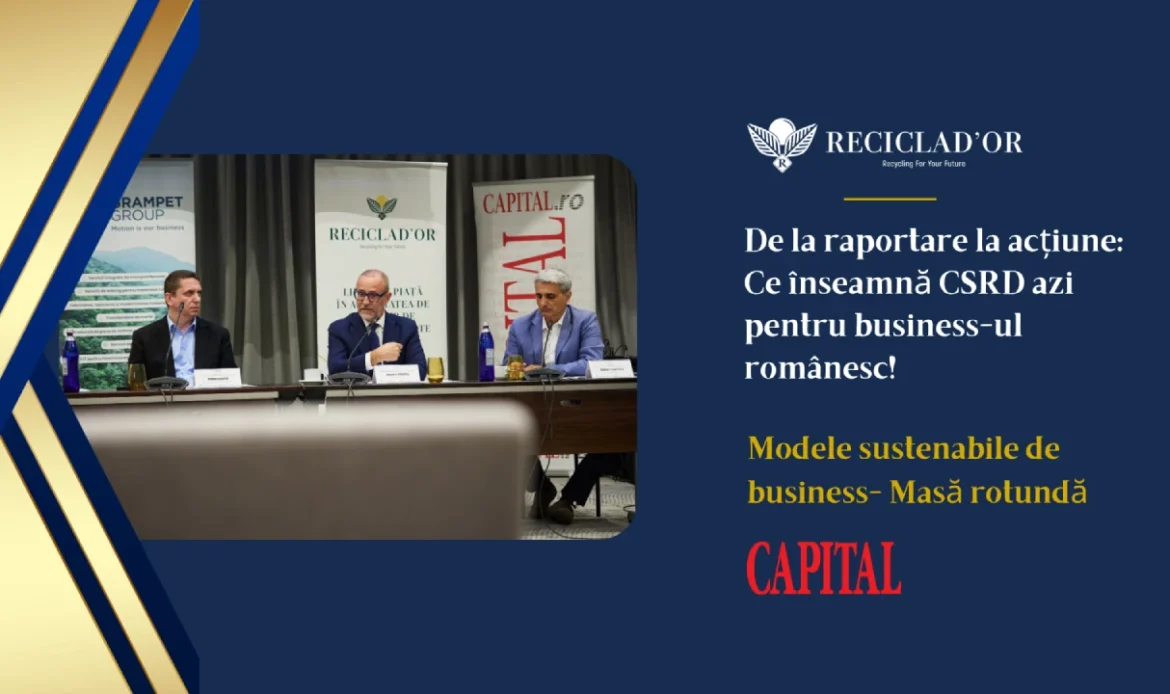
From reporting to action: what sustainability means today for Romanian business
Reciclad’OR, partner of the Capital roundtable on sustainability in Romanian business | Bucharest, June 16, 2026
What does sustainability mean for Romanian business in 2026? On June 16, Capital brought together at the same roundtable leaders from energy, the food industry, transport, academia, and consulting to discuss, concretely, what it means to build a sustainable business. The event, “Sustainable business models. The real costs of sustainability” — put forward not the myth of sustainability as a corporate image, but its reality: with costs, deadlines, opportunities, and pressures that do not disappear through any press release.
Reciclad’OR participated as a partner, represented in the debate by Marius Brînzea, Strategy Director, who brought into discussion the perspective of a direct player in the circular economy ecosystem — with data, not statements.
12 years of Romanian business sustainability: from voluntary to mandatory
Marius Brînzea opened with a timeline that few still know in detail. The NFRD from 2014, voluntary for the majority. The Green Deal from 2019, which transformed sustainability from a fad into a strategic pillar. CSRD from 2022, which brought mandatory requirements and real sanctions. And the ESRS standards from 2023, with double materiality as a key principle.
But the most important change is not in the timeline — it is in the present. Omnibus I, which entered into force on March 18, 2026, redefined who is still covered by CSRD: the thresholds have increased fourfold, from 250 employees and €50 million turnover, to 1,000 employees and €450 million. The direct effect: out of the approximately 50,000 companies initially targeted at European level, only around 5,000 remain. Ninety percent fall out of the legal obligation.
Added to this is the simplified ESRS draft, published on May 6, 2026, by the European Commission: the number of mandatory data points decreases by 61% compared to Set 1. And VSME — the voluntary standard for SMEs, formalized with a “value chain cap” that gives companies with under 1,000 employees the legal right to refuse requests that exceed the standard.
“It sounds like a relaxation, but it is not,” said Brînzea. “The underlying direction remains unchanged — the same objectives, the same double materiality, the same third-party assurance. The speed and scope have changed. This is a calibration, not a withdrawal.”
Romanian business sustainability: the operational paradox
The most important message from the second intervention of the Reciclad’OR Strategy Director was a counterintuitive one: the reduction of the CSRD scope does not reduce operational pressure. Sustainability requirements are moving from legislation to the market.
The approximately 45,000 companies that have fallen out of scope remain in the value chain of the 5,000 that continue to report. Those 5,000 must collect data across the entire chain — suppliers, distributors, retailers, subcontractors — based on articles that remain unchanged by Omnibus. The pressure does not disappear; it shifts from Brussels to the market. And the market, as Brînzea emphasized, is often messier than the European legislator.
Outside of CSRD, the requirements remain intact: banks through SFDR, investors through the EU Taxonomy, CSDDD due diligence from 2029, ESG clauses in contracts. “Value chain demands do not disappear; they move from legislation to the market,” he said. “And market demand is, as a rule, messier than Brussels’.”
Real gains do exist, however: a more relaxed timeline — waves 2 and 3 postponed to the 2027 financial year — legal protections for omitting trade secrets, and, most importantly, more professional judgment: the decision on materiality becomes managerial, not prescribed. Brînzea’s practical conclusion: standardize everything on VSME, refuse ad-hoc questionnaires, and use the legal right to refuse. “Whoever standardizes now wins; whoever treats sustainability as a quick fix will pay twice.”
The real cost of sustainability in business: €25.4 trillion lost annually
If the first two responses dealt with regulation, the third moved the discussion to where it truly matters for Romanian business sustainability.
The savings in reporting are real: according to the EFRAG cost-benefit analysis, costs decrease by 44% for the 2027–2031 period — approximately €4.7 billion saved at the EU level. From 2029, stable annual savings of 33–36%. But, Brînzea insisted, these are surface-level figures.
The Circularity Gap Report 2026, produced by Circle Economy with Deloitte, quantifies the structural loss of the global linear economy at €25.4 trillion annually — approximately 31% of global GDP. “For every three euros we create, one is lost because we are linear, not circular,” he said.
And Romania is in the worst possible position: a circularity rate of 1.3%, 27th out of 27 in the European Union, ten times below the European average of 12.2% and twenty-five times below the Netherlands. We are 74% below our own assumed target for 2025. We have four years to reach 10% — and this distance is not covered by any report: it is covered by real investments in collection, sorting, and recycling infrastructure.
The mechanism blocking the transition is well known: fossil fuel subsidies of around $1.4 trillion per year globally keep virgin raw materials artificially cheaper than recycled ones. Virgin plastic costs between €1.20 and €1.50/kg; recycled plastic, between €1.40 and €1.80/kg. Without subsidies, the ratio reverses. “The difference is given exclusively by subsidy policy, not operational efficiency,” Brînzea explained.
The final conclusion was direct: “Regulation gives us the map and gives us the time — 24 months. But the map does not collect, sort, or recycle. Real economic value is unlocked only when we move from reporting to doing.”
A debate on sustainability in business that went beyond compliance
The roundtable did not remain at the level of regulation. Alongside Marius Brînzea, the debate was contributed to by Tulia Casvean (Corporate Communication & PR Director, Transavia SA), Teodora Mărăcineanu (Marketing Director, Electrolux Group), Cristina Bălan (Senior Partner Sustainability, CSR BootIQ), prof. univ. dr. Voicu Dan Dragomir (Bucharest University of Economic Studies), Sorin Chiriță (Director, SAPE), Virgil Profeanu (Founder, VEGO), Radu Balcu (General Manager, GP Intermodal), Florin Danilă (General Manager and Founder, Cumpăna 1993)
Together, they brought into discussion solutions, challenges, and good practices for a more responsible and future-ready business environment — from reporting models adapted to the Romanian reality, to concrete examples of integrating sustainability into value chains, to the pressures faced by companies in very different industries.
The common conclusion came out of the debate, not from any press release: sustainability in Romanian business is no longer a strategic option for companies that want to remain relevant. It is infrastructure. And infrastructure is built, not reported.
The voice that matters
Reciclad’OR is a market leader in responsibility transfer activity in Romania — because sustainability is not a report, it is infrastructure.
Over 1,200 companies did not choose the same OIREP by chance.
Reciclad’OR — the voice that matters when responsibility also means results.
Because we believe sustainability is not driven by obligation. It is driven by vision.
Reciclad’OR is one of the most important OIREP organisations in Romania, with expertise in transfer of responsibility, collection and recycling, environmental consulting and circular economy.
If you are a producer, importer or retailer and want to understand how you can efficiently fulfill your recycling responsibilities, we are here!
How useful was this post?
Click on a star to rate it!
Average rating 0 / 5. Vote count: 0
No votes so far! Be the first to rate this post.
We are sorry that this post was not useful for you!
Let us improve this post!
Tell us how we can improve this post?