Update on the Strict Regulations Regarding the Use of Bisphenol A (BPA) in Products
Working with over 1,350 companies across multiple industrial sectors, one of the most recent and frequently raised requests to the consultancy department concerns the use of bisphenol A (BPA) in finished products.
This concern arises in the context of Regulation (EU) 2024/3190, which prohibits the use of BPA in many single-use items starting from 20 July 2026.
To correctly understand the regulation and the legal requirements, we must outline in chronological order the legislative acts that define these obligations:
- First of all, the Packaging and Packaging Waste Regulation (PPWR) does not regulate provisions relating to BPA.
- The applicable act for BPA is Commission Regulation (EU) 2024/3190, adopted on 19 December 2024. The Regulation establishes rules on the use of bisphenol A (BPA) and certain bisphenols/derivatives in materials and objects intended to come into contact with food, and includes provisions on prohibitions and transitional measures. The European Commission subsequently published a „Note for Guidance“ for its implementation (C/2025/6721). The document contains practical clarifications (scope, compliance evidence, declarations of conformity, transitional provisions, and industry-applicable examples). We recommend using this document for interpreting deadlines and technical obligations. The guidance clarifies how transitional deadlines apply (e.g., what „first placing on the market” means, how stock depletion applies, what evidence/documents must be kept for the declaration of conformity).
- On 2 February 2026, the European Commission adopted Regulation (EU) 2026/250, a corrective measure designed to clarify specific provisions of the previous legislation (Regulation (EU) 2024/3190) and to ensure its consistent application across the EU. This regulation entered into force on 23 February 2026. Although the new regulation does not change the overall objective of BPA restrictions in food contact materials, it introduces important clarifications regarding analytical verification, transitional periods for certain products, and documentation requirements within the supply chain.
What are the core provisions of Regulation (EU) 2024/3190?
- Reg. (EU) 2024/3190 prohibits the use of BPA in food contact materials and establishes transitional provisions (Art. 10 para. (1)–(2)).
- For many single-use articles, the last date for placing on the market is 20 July 2026 (Art. 11 para. (1)).
- For certain reusable articles, extended deadlines exist (e.g. some reusable items until 20 July 2027), and for certain reusable professional equipment the final deadline may be 20 January 2029 (Art. 12 para. (1), (2) and (3)).
- Products already placed on the market before the applicable deadlines may be sold and used in accordance with the stock depletion periods indicated in the regulation (e.g.: until 20 January 2029 in certain professional cases) (Art. 12 para. (3)).
What important changes does Regulation (EU) 2026/250 bring?
- Analytical verification: a key element of the correction concerns the analytical verification of BPA residues in packaging materials. The Regulation underlines that food contact materials must not contain residual BPA or other hazardous bisphenols above the established detection limits.
2. Clarified transitional provisions, allowing certain articles manufactured under the previous legislative framework to remain on the market for specific periods:
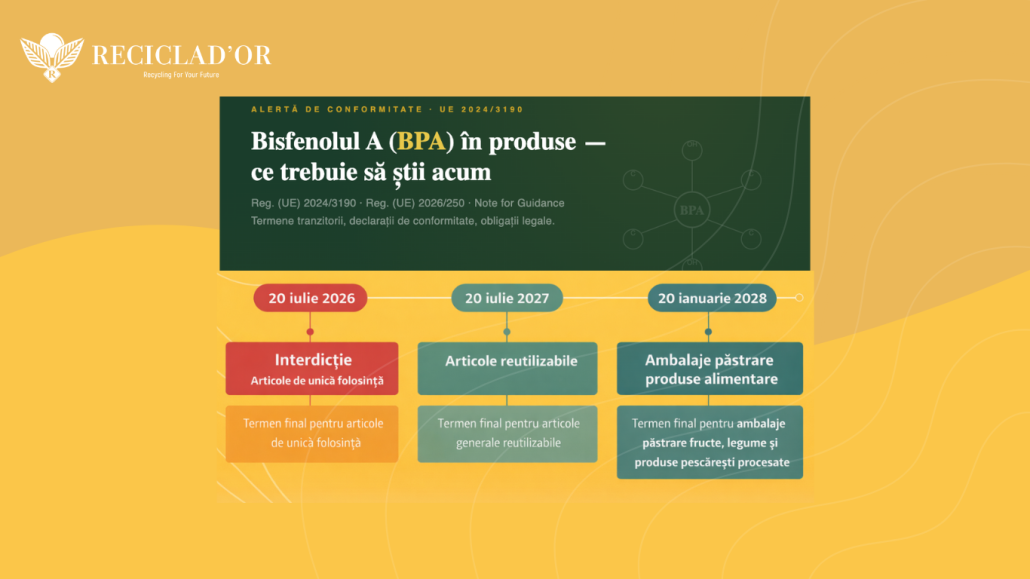
- For final single-use articles intended for food contact, the deadline for first placing on the market is 20 July 2026.
- For packaging intended for storing processed fruits, vegetables and fishery products, the deadline for first placing on the market is 20 January 2028. After the above expiry, a 12-month window is allowed for filling and sealing these articles. Any food packaged during this period may remain on the market until stock is depleted.
- General reusable articles may remain on the market until 20 July 2027.
- Reusable professional equipment for food production may remain on the market until 20 January 2029.
These deadlines provide a clearer legislative pathway for companies that still hold compliant products manufactured under previous legislation. By defining precise transition periods, the regulation helps industry players plan stock management, adjust production processes, and transition to BPA-free alternatives.
3. Adjustments to Declaration of Conformity requirements: Regulation (EU) 2026/250 introduces an important clarification regarding the requirements for Declarations of Conformity (DoC). The previous wording required the identification of both intermediate materials and final articles intended for food contact in the same declaration. However, this approach raised concerns for companies in the supply chain regarding the possible disclosure of confidential supply chain information. The correction amends the requirement so that the declaration specifies the identity of the intermediate food contact material OR the final food contact article for which the declaration is issued. This adjustment ensures transparency and traceability, while at the same time allowing companies to protect sensitive commercial information.
In accordance with the recent amendments introduced by the Corrective Regulation, companies will verify whether they can still place on the market products/packaging containing BPA, taking into account the transitional measures and the product/packaging categories (single-use vs. reusable vs. professional equipment).
Reciclad’OR provides its partners with consultancy and support in conformity assessment, the development of a stock transition plan, and assistance with declarations of conformity.
Reciclad’OR is one of the most important OIREP-type organisations in Romania, with expertise in responsibility transfer, collection and recycling, environmental consultancy, and circular economy.
If you are a producer, importer or retailer and want to understand how these profound legislative changes affect your business and how you can efficiently fulfil your recycling responsibilities, we are here.