CircularEcon 2026: The Circular Economy Is No Longer an Option; It’s a Business Strategy
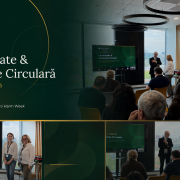
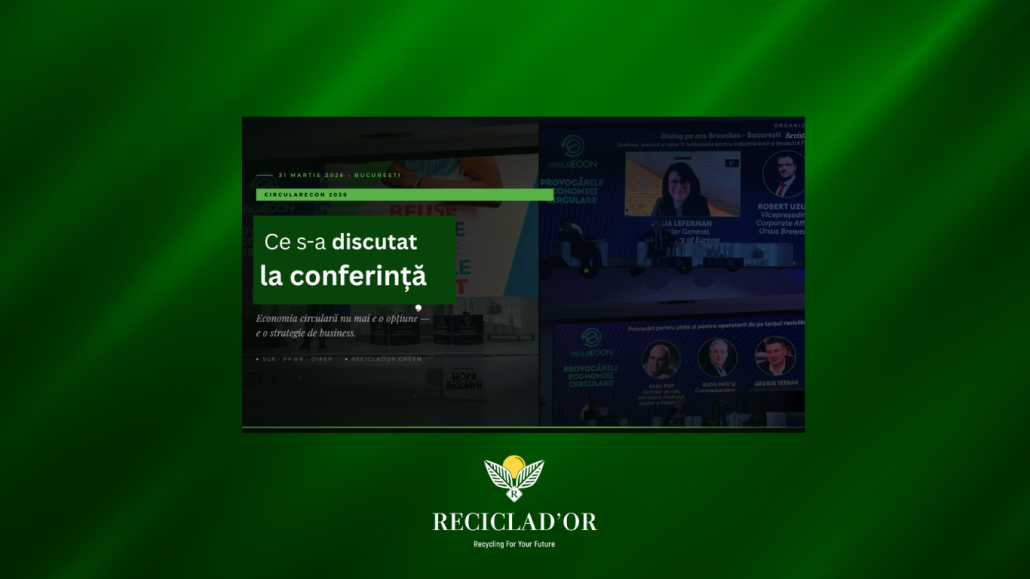
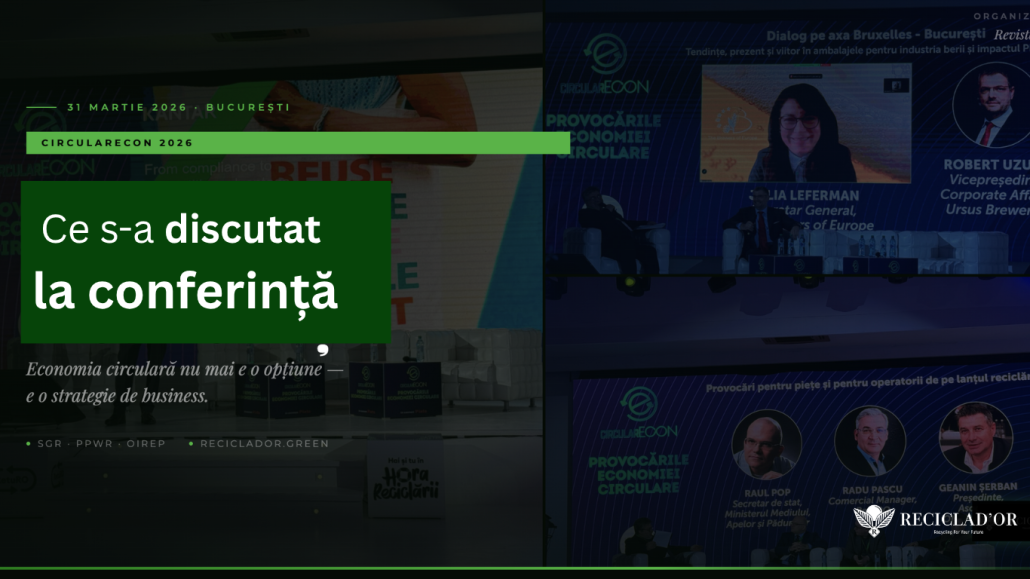
On March 31, 2026, the CircularECON hall was packed. And not by chance — this edition marked the shift from declarative discussions about sustainability to concrete arguments, real figures, and the healthy tension between what the European regulator wants and what local industry can deliver today.
CircularECON 2026, a conference organized annually by Revista Piața, confirmed that European pressure will increase significantly through PPWR and that Romania has a long road ahead to reach the EU average. That is why Reciclad’OR continues its series of monthly PPWR-dedicated workshops — a practical tool available to our partners, to navigate with clarity the most comprehensive European regulation on packaging in the last two decades. Below, we present the key takeaways from this year’s edition of CircularEcon.
1. From Compliance to Competitive Advantage
The Kantar presentation cut straight to the point: circular packaging is no longer a compliance burden. It is a differentiation tool. Brands that understand that packaging sustainability can create perceived value among consumers — not just avoid fines — are the ones that will gain market share in the years ahead.
Key takeaway: If you still treat PPWR or SGR as a compliance cost, you risk leaving a competitive advantage in the hands of faster competitors.
2. SGR Is Working — But the Real Conversation Is Just Beginning
Robert Uzuna, Vice President of Corporate Affairs at Ursus Breweries, complemented the perspective from within the brewing industry — an industry with complex packaging cycles that had to recalibrate rapidly.
Key takeaway: SGR is not a completed project. It is an ecosystem under construction. Producers who actively engage in its optimization will have a say in what tomorrow’s rules look like.
3. The Brussels–Bucharest Dialogue: PPWR and the Reality on the Ground
Julia Leferman, Director General of The Brewers of Europe, participated online — and her presence marked the most interesting moment of the conference: the constructive confrontation between PPWR’s ambitions and the Romanian market’s actual capacity to absorb them.
Trends in packaging for the brewing industry are clear: weight reduction, increasing the share of recycled material, design for recyclability. But the pace of implementation, support for small operators, and financing mechanisms remain open questions.
Key takeaway: PPWR is not a threat for those who are prepared. It is a framework. The challenge is keeping up with its correct interpretation — and that requires partners who understand both the regulation and the operational reality.
Official data presented in the panel (source: AFM, Eurostat):
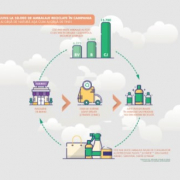
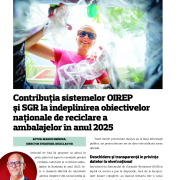
- OIREP + SGR together collected 1,464,783,480 kg of packaging waste in 2025 — exceeding the minimum requirement of 1,409,989,680 kg.
- The contribution was not equal: 76% came from the OIREP system (1,112,085,937 kg), and 24% from SGR (352,697,543 kg).
- Romania: recycling rate of 37.3% vs. the European average of 67.5% and the 70% target for 2030.
Key takeaway: The 76% figure speaks for itself. OIREP is not a secondary system compared to SGR — it is the backbone of packaging recycling in Romania.
Why OIREPs Are Essential — and Why Romania Cannot Afford to Ignore Them
Seven EU member states have already reached the 70% recycling target for 2030 — Belgium, the Netherlands, Italy, the Czech Republic, Slovenia, Slovakia, and Spain. Most of them got there exclusively through well-established OIREP systems, not through deposit-return systems.
Why SGR alone is not enough:
Mature SGR systems in Europe reach a natural performance ceiling — somewhere between 80–90% collection rate for the targeted packaging.
Beyond this threshold, further growth potential becomes structurally limited.
SGR is an effective tool for a specific segment (PET, cans, bottles) — but it cannot alone cover the entire packaging recycling equation.
What Romania must do:
- Investments in modernizing and consolidating OIREP infrastructure
- Ongoing public education for correct separate collection
- Creating a predictable and stable framework for operators in the recycling chain
Key takeaway: Treating OIREP as a secondary system compared to SGR is not an opinion — it is a strategic error with direct consequences for Romania’s ability to meet its European recycling targets.
5. The Recycling Chain: Real Vulnerabilities, Real Opportunities
Beyond the figures, the panel opened a necessary discussion about the economic health of the entire chain: the volatility of recycled material prices, limited processing capacities, and the need for massive infrastructure investment.
Key takeaway: The circular economy only works if every link in the chain is economically viable. Ignoring the profitability of recycling operators means ignoring the functioning of the entire system.
6. Conclusions from CircularECON 2026
Packaging sustainability = brand strategy — not just a legal obligation
SGR is a good foundation — but scaling requires active involvement from all stakeholders
PPWR comes with complex requirements — preparation starts now, not in 2027
OIREP accounts for 76% of packaging recycling — it is the backbone, not an alternative
7 EU countries have already reached 70% — exclusively through well-established OIREP systems
Romania is at 37.3% vs. the EU average of 67.5% — the road is long and requires investment, not rhetoric
The industry–state–EU dialogue must be data-driven — not based on impressions or short-term interests
What Does This Mean for You, as a Producer or Importer of Packaged Products?
If you want to understand how PPWR affects you, what extended producer responsibility means in practice, how you can optimize your packaging in light of SGR, or how to turn compliance into a real business advantage, Reciclad’OR has good news for you.
In the context of the adoption of the Draft Commission Notice on the Guidance document for Regulation (EU) 2025/40 on Packaging and Packaging Waste (PPWR), we have doubled the number of technical-legal workshops dedicated to PPWR and moved from a general format to targeted workshops, addressed by stakeholder category and specific topics — EPR, labeling, Design for Recyclability, PFAS, DRS, reuse, compostability.
Find the full workshop calendar here.
The first workshop in the new series takes place on April 23 — register here.
Reciclad’OR is one of the most important OIREP-type organizations in Romania, with expertise in responsibility transfer, collection and recycling, environmental consulting, and circular economy.
If you are a producer, importer, or retailer and want to understand how to efficiently fulfill your recycling responsibilities, we are here for you!