
Marius Brînzea, Reciclad`OR: “Environmental policies should ensure a predictable coherent framework for extended producer responsibility schemes”
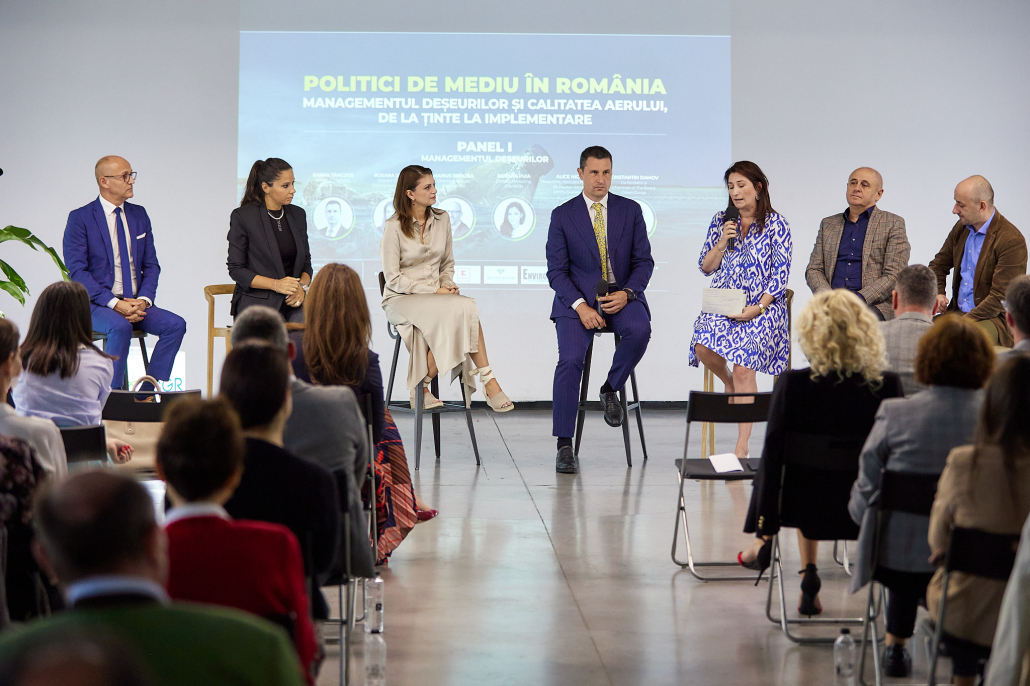
Environmental policies in Romania will have to ensure a specific predictable coherent framework for extended producer responsibility schemes so that they provide circular material and allow all parties involved in the value chain to become circular, Marius Brînzea, Strategy Director, Reciclad’OR, said on Wednesday at the conference “Environmental Policies in Romania. Waste management and air quality”, organised by Green Report.
“I believe that the success of a transition to a circular economy is assured by an already proven and feasible way at European level to enable continuous, dedicated and scaled funding, and this can be done through extended producer responsibility schemes. Other hybrid alternatives, state subsidies, voluntary agreements cannot ensure development at scale, continuity, efficiency and, importantly, sufficiency. I would say that we are at a point where the future no longer allows us to experiment,” said Marius Brînzea.
According to his statements, he identified four critical success factors for environmental policies in the transition to the circular economy and, in particular, in relation to extended producer responsibility.
“The first, which I consider the most important, is the sharing of obligations along the value chain and the precise establishment of roles and responsibilities. Succinct. We’re talking about government, we’re talking about coherent policies and very clear, long-term goals. We are talking about local authorities, we are talking about ensuring a well-functioning infrastructure and transparent operation. We’re talking about producers, we’re talking about modelling and continually refining extended producer responsibility schemes,” explained Reciclad’OR’s Director of Strategy.
A second factor is to ensure transparency on data and financial flows, at national level, across the value chain.
The third factor is the creation of independent instruments to oversee competition at all levels of the value chain, including the extended producer responsibility part.
“At European level, there is a massive process of moving compliant markets where extended producer liability used to operate to competitive markets, an example is France”, explained Marius Brînzea. “The fourth factor is the possible involvement, and the need for involvement, in fact, of other ministries in the case of the adoption of legislation that has an impact and extremely deep ramifications on the value chain, because synergies must be created, and here the Ministry of Economy comes to mind. And last but not least the development of dialogue platforms.“
Source:https://green-report.ro