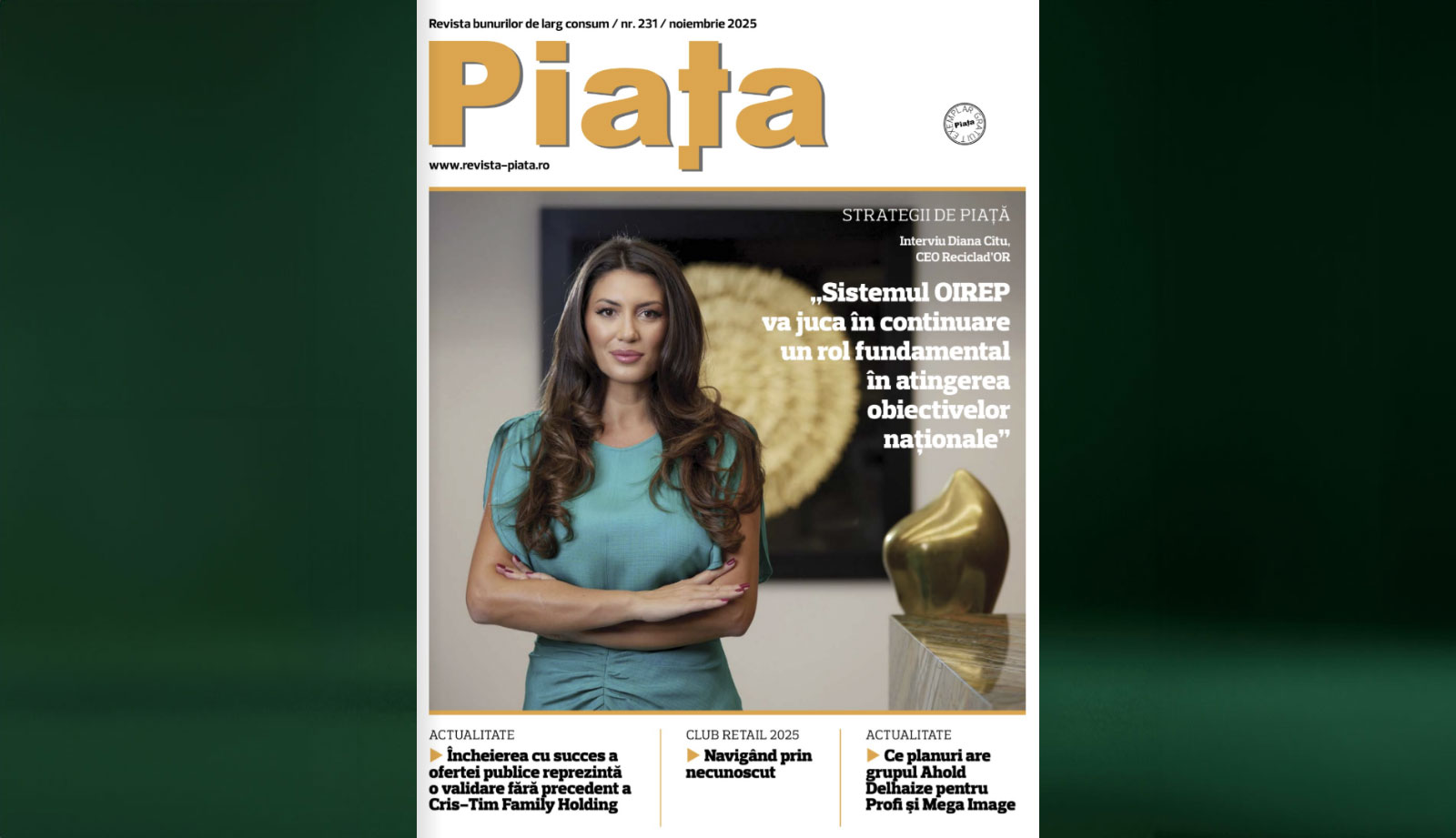
Diana Cîtu, CEO of Reciclad’OR: “The OIREP system will continue to play a fundamental role in achieving national targets.”
2025 has been a very challenging year for the business environment. How were these challenges felt in the area of responsibility transfer and what changes influenced this activity?
In 2025, the most important challenge in taking over responsibility for packaging recycling was achieving the legally established recycling targets agreed contractually with the more than 1,300 partners in Reciclad’OR’s portfolio. The significant increase in recycling targets—25% for plastic and wood, 7% for paper and cardboard and 8% for metal—placed strong pressure on our efforts to collect the additional quantities needed to meet these objectives.
The increase in the overall annual recovery target from 65% to 70%, combined with the impact generated by the implementation of the deposit-return system, deficiencies in household separate collection systems and the low recyclability rate of certain types of packaging, created additional pressure on our activity. All these factors had a significant impact on the supply chain, immediately reflected in higher chain-specific costs and difficulties in accessing collected materials.
The increase in costs across the packaging waste supply chain has been significant and, in the current context, we believe this trend will continue in the long term.
With what results does Reciclad’OR close 2025 and what are the forecasts for next year?
First of all, we are pleased that, despite the national-level difficulties and major increases in targets, this year as well—just like in all eight years of activity—we will successfully meet all recovery and recycling objectives for all our partners.
According to the results recorded as of October 2025, we took over responsibility for packaging recycling for more than 1,300 companies, representing over 235,000 tonnes of packaging placed on the market. Naturally, we will be able to publish the final and detailed results in early February 2026.
From an economic perspective, for 2025 we estimate a turnover of over RON 104 million.
Looking ahead (2026–2030), we anticipate a significant increase in our partner portfolio and, implicitly, in the quantities of packaging for which we will assume legal recycling responsibilities. We believe that future consumption behaviors and macroeconomic developments will directly and significantly influence these volumes.
In addition, our sector, like many others, will feel the impact of cost increases generated by certain legislative regulations. If the current deficiencies in the packaging waste supply chain are not remedied, they will lead to an exponential increase in specific costs. We are aware of this risk and therefore make constant operational and strategic efforts to ensure efficiency and continuity in our activity.

From Reciclad’OR’s perspective, how has the responsibility transfer market evolved in recent years and how does the company contribute to achieving recycling targets?
In the context of increasing recycling targets, the implementation of the deposit-return system (DRS) and permanent, high-performance national monitoring systems, over the past two years we have seen a reduction in the number of participants in the responsibility transfer market. Their exit was driven by both legal and economic considerations.
In 2024, responsibility transfer ensured through OIREPs registered a quantitative decline due to the implementation of the DRS and the mandatory migration of certain packaging quantities to this system.
According to public data, in 2023 compliance with extended producer responsibility obligations for packaging was achieved 99.99% through OIREPs and only 0.1% through the DRS. In 2024, this distribution changed significantly, with 77.78% of obligations covered through OIREPs and 22.22% through the DRS. From an economic perspective, the total turnover of the responsibility transfer market decreased substantially, from approximately RON 818 million in 2023 to about RON 605 million in 2024.
Even in the context of DRS implementation, the OIREP system plays—and will continue to play—a fundamental role in achieving Romania’s national targets in relation to the European Union.
This must be explained in detail. While in 2024 the OIREP system, which manages all types of packaging, accounted for over 1.6 million tonnes of packaging for which responsibility was assumed, the DRS is limited to only 455,000 tonnes, managing exclusively packaging between 0.1 and 3 liters for certain beverages.
Considering the recycling targets achieved relative to the assumed quantities, the contribution of OIREPs to meeting national recycling targets exceeds 72%. With a market share of over 15%, Reciclad’OR contributes significantly to achieving these objectives and is an essential player in ensuring Romania meets its commitments within the European Union.
What strategic directions enabled Reciclad’OR to ensure business growth during this period, from the perspective of meeting recycling targets and responsibility transfer performance?
During this period, Reciclad’OR strengthened its position on the national market through a series of strategic directions aimed simultaneously at meeting contractually assumed recycling targets and improving the quality of services provided to our partners.
These strategic directions are aligned with the regulated nature of our activity and with partners’ specific needs, in the context of complex national and European legislation and the transition to a circular economy.
From the perspective of achieving recycling targets, we focus on:
→ Securing collection, sorting and recycling operations and expanding local and regional strategic partnerships;
→ Intensifying collaboration with public sector partners to increase volumes of waste collected from households;
→ Improving and diversifying monitoring and control tools to ensure 100% traceability of reported packaging waste;
→ Ensuring supply chain sustainability through appropriate financial management correlated with macroeconomic and market developments.
From the perspective of service quality for partners, we focus on:
→ Developing our service portfolio in line with unmet partner needs, in the context of new EU requirements on packaging, circular economy and sustainability reporting;
→ Improving and adapting data management systems to specific legislative requirements;
→ Assessing Reciclad’OR’s and each partner’s contribution to reducing greenhouse gas emissions through packaging recovery and recycling—CO₂ emissions certification;
→ Developing programs and workshops dedicated to packaging, circular economy and sustainability;
→ Diversifying and intensifying education and information programs developed with partners to promote responsible consumer behavior.

What were the biggest challenges faced during the eight years of activity? And the most important achievements?
Without a doubt, the biggest challenges were generated by national legislative changes regarding packaging and packaging waste management.
These changes generally have significant economic, operational and legal impacts on the supply chain and are difficult to predict. The impact manifested through cost increases, changes in traceability documentation and data reporting, as well as adjustments in collaboration with economic operators and local authorities.
We should also mention the challenges generated by the COVID-19 pandemic and macroeconomic turbulence, which Reciclad’OR successfully navigated. In particular, our supply chain underwent unexpected changes.
However, based on a solid business plan and well-structured risk management, we managed unforeseen situations successfully, which are nevertheless specific to our sector.
European regulations on single-use packaging, circular economy, sustainability reporting and, more recently, the Packaging and Packaging Waste Regulation, generate both challenges and opportunities to improve performance in this field.
Regarding achievements, the most important remains the successful fulfillment of all recycling obligations for all our clients throughout all eight years of activity, confirmed by state authority inspections and annual reports. During this period, we met and exceeded recovery and recycling obligations for over 1.8 billion kg of packaging placed on the market.
Another notable achievement is nationwide coverage and the development of sustainable partnerships with over 150 operators involved in the collection, sorting and recycling chain.
The development of our service portfolio is fundamental to Reciclad’OR’s evolution—from the implementation of the e-Reciclare online reporting platform to webinars, technical workshops and sustainability reporting themes. Over 91% of partners responding to our annual satisfaction survey declared they are very satisfied with our services.
We are also proud of our efforts to educate citizens and consumers. Through over 300 campaigns, we helped educate more than 5 million Romanians on the importance of separate packaging collection.
Team growth and professional performance are another source of pride. Today, Reciclad’OR has 33 specialists, supported by CRM systems and ISO 9001 and 14001 standards.
Reciclad’OR is currently perceived nationally as a company capable of meeting 100% of contractual obligations without financial risk and with the most extensive service portfolio.
What impact did the DRS have on the business model and how did Romanian OIREPs adapt?
We previously mentioned the impact of the Deposit-Return System (DRS) on the OIREP system, through the migration of certain packaging from one system to another, and emphasized that the OIREP system represents and will continue to represent the fundamental pillar for fulfilling Romania’s recycling obligations in relation to the European Union.
From an individual perspective, the implementation of the DRS in 2024 resulted in a 22.2% reduction in the volumes of packaging waste managed by Reciclad’OR. Naturally, this decrease was also felt economically, influencing the company’s financial scale.
Most importantly, this impact was fully managed by our management team through the development of a well-structured business plan and detailed scenarios regarding the transition of quantities to the DRS. These plans and scenarios were developed as early as 2021. As a result, we were able to control and efficiently manage this change, ensuring the continuity and stability of our operations and those of our partners.
What regulatory changes would boost the responsibility transfer sector?
Key legislative changes should prioritize household separate collection, monitoring of supply chain activities and OIREP licensing. Improved transparency, cost alignment with performance indicators and enforcement would increase predictability and efficiency.
Given that OIREPs contribute significantly to achieving national targets and that performance in this area largely depends on the efficiency of separate packaging collection from the municipal waste stream, the main regulations should primarily focus on household separate collection systems, on informing and educating citizens and enforcing penalties for non-compliance, as well as on transparency of collection costs and aligning these costs with performance indicators. At present, the costs requested by certain local authorities are unjustified and, more seriously, reflect major operational inefficiencies. Intervention in this area would increase predictability across the supply chain, facilitating the identification of appropriate measures to raise separate packaging collection rates at household level.
From the perspective of performance monitoring across the entire chain, the positive impact of implementing the SIATD system has been evident. Clear and accurate data reporting is essential in any economic activity, including ours.
Last but not least, the annual licensing and authorization process must be reviewed and made more transparent, in line with similar developments in other European countries, adapted to Romania’s economic and operational realities, as well as to the new European Union requirements on extended producer responsibility. All these changes would lead to significant improvements in the activity of the packaging recycling responsibility transfer sector, with positive effects for producers and importers.

Much is said about the transition to a circular economy, but too few concrete actions are taken. Reciclad’OR has stood out as a pioneer in addressing circularity for its clients. What have their reactions been and what results have been achieved through this partnership?
The circular economy represents a complex concept, with multiple implications for all business stakeholders. Circular economic models will emerge and become a long-term reality, influencing all industrial sectors at local, regional and global levels. The transition from a linear economy to a circular economy will reshape the competitive positions of supply chain actors, and internalizing this concept will represent a real challenge for the economic sector.
It is important to emphasize that this transition is a long-term process, as business models cannot be changed overnight. Any reform of such magnitude involves significant risks, which must be managed with the utmost responsibility.
In this context, we were pioneers in the field, launching the Circular Economy Training program in the spring of 2021, which enjoyed genuine success within the Romanian industry. Within this program, we focused on deepening the understanding of circular economy concepts, principles and drivers, as well as the interconnections between them. We addressed the economic and operational implications generated by the New Circular Economy Action Plan, as well as the basic notions of business model innovation from the perspective of the requirements and opportunities offered by the circular economy. We also presented methodologies and tools useful for identifying circularity opportunities within companies.
We paid special attention to change management and organizational culture in the context of the circular economy, alongside the presentation of a set of relevant and field-specific case studies, analyses, research and best practices.
The circular economy training sessions were held either at our headquarters or at our partners’ locations, and the results achieved were exceptional. Since its launch, over 600 representatives from more than 200 partner companies have participated in this program. The participants’ feedback, transparently expressed and published on the Reciclad’OR website, clearly reflects the value and relevance of the expertise delivered through this training.
How does Reciclad’OR support partners regarding new packaging and sustainability reporting requirements?
Given the significant implications of the EU Packaging and Packaging Waste Regulation (PPWR), as well as companies’ obligations regarding sustainability reporting under the EU Corporate Sustainability Reporting Directive (CSRD), we launched two dedicated workshops in January this year—one focused on PPWR and the other on CSRD.
The Reciclad’OR workshop dedicated to PPWR aims to support the understanding of the complex requirements imposed by the EU Packaging and Packaging Waste Regulation and to help companies align with the new regulations. The expertise provided within this workshop addresses the following aspects:
→ An overview of the Regulation and the context of its adoption;
→ A detailed explanation of all measures with direct and indirect impact on companies, such as reuse targets, recycled plastic content, packaging recyclability classification (DfR), restrictions on certain types of packaging, online sales and the reduction of packaging per capita;
→ An analysis of the PPWR’s impact, with a focus on identifying companies’ legal obligations, implementation timelines and assessing financial and logistical impacts;
→ Viable implementation strategies and the development of an action plan.
The Reciclad’OR workshop dedicated to CSRD helps companies understand the requirements of the EU Corporate Sustainability Reporting Directive and the European Sustainability Reporting Standards (ESRS). The expertise delivered within this seminar focuses on:
→ Understanding and clarifying the new CSRD and ESRS requirements;
→ Analyzing the critical elements of the CSRD Directive;
→ Risk and Opportunity Impact Assessment (IRO) and practical explanations of the double materiality assessment process;
→ Identifying the reporting process in line with CSRD requirements;
→ Presenting technical solutions, tools and applications useful in the reporting process;
→ Analyzing aspects related to data preparation, monitoring and auditing.
The schedule for these workshops is publicly available on the Reciclad’OR website, and the level of interest shown by participants has been exceptionally high.
What new services are planned for next year?
Following research conducted during the 2024–2025 period, aimed at aligning companies with sustainability reporting requirements and with the requirements related to packaging and packaging waste, we identified a series of unmet needs in these areas. As a result, in January 2026 we will launch the SustainabilityPRO online platform, designed to provide Reciclad’OR partners with centralized access to a range of structured, specific and highly useful information, including but not limited to the following:
→ Ongoing legislative updates related to delegated acts (3), implementing acts (14), revisions, specific guidelines and new packaging standards (38), in line with the provisions of the PPWR;
→ Mechanisms for assessing packaging portfolios against PPWR requirements—recyclability, reuse, recycled plastic content, minimization, market placement restrictions, labeling, etc.;
→ All the information required to ensure and streamline the sustainability reporting process, in compliance with CSRD requirements;
→ Ongoing legislative updates related to CSRD (e.g. the OMNIBUS initiatives);
→ Essential tools for the sustainability reporting process (e.g. applications for double materiality assessment and CSRD reporting);
→ Thematic online workshops;
→ Specialized studies and analyses;
→ Educational and informational materials dedicated to the management of packaging and packaging waste data (reporting, packaging databases, etc.).
We will return in January with full details regarding the platform’s content, role and access modalities.
What are the most important consumer education and awareness projects and campaigns implemented by Reciclad’OR, and what objectives do you have for the coming year?
At Reciclad’OR, CSR is an integral part of our business model.
Reciclad’OR succeeds in bringing impactful CSR campaigns and projects into the lives of Romanians, all aimed at helping to build a better future.
Over eight years of performance, the Reciclad’OR team has managed to maintain its position as a trendsetter in the CSR space. The company has developed more than 300 social responsibility projects and campaigns, recognized both nationally and internationally. The diversity of initiatives launched through our CSR department is extensive, ranging from eco-educational projects organized within educational institutions, environmental conferences and customized workshops dedicated to Reciclad’OR partners, to festivals and concerts where we developed a strong sustainability component. Each year, Reciclad’OR prepares a CSR Report covering all awareness and information campaigns, including performance indicators (KPIs) for each type of initiative.
One of the major projects we were involved in was “Recycling Tour – The Pollution-Free Race – L’Étape Romania by Tour de France,” where Reciclad’OR experts ensured that the event was “100% green.” Strong emphasis was placed on reducing pollution and CO₂ emissions through the use of alternative, more environmentally friendly methods, positioning Romania on the podium among the most eco-responsible cycling events in the world.
Recycling knows no borders, and this vision was supported through a Reciclad’OR-led project: “Together for Our Planet!” at the ITU Plenipotentiary Conference 2022. The event took place over three weeks and brought together 4,000 participants, including heads of state and high-level officials from 193 countries.
We will continue this tradition in the years ahead. Expanding CSR campaigns at national level, strengthening public–private partnerships and developing sustainable projects together with our partners will remain core strategic directions for Reciclad’OR.
Does Romania have the capacity to meet the recycling targets set by the European Union? How do you think the recycling market in Romania will evolve in the coming years?
Romania has considerable potential to meet the recycling targets established by the European Union, but achieving this goal will largely depend on the coordinated efforts of all stakeholders involved—authorities, the business community, collectors, sorters, recyclers and consumers. However, significant investments are needed in separate collection infrastructure at household level, in high-performance collection and sorting technologies, as well as in citizen education and awareness programs, in order to increase separate collection rates and improve the efficiency of the entire recycling process.
At the same time, the management of relevant data at national level must be improved, and the collected data must be made transparent and properly analyzed, so that future risks and development opportunities can be accurately identified.
In the long term, Romania’s packaging recycling market will undergo significant evolution, driven both by the new regulations introduced by the PPWR and by technological advances and changes in consumer behavior. A continuous increase in the volume of waste collected and recycled is expected, along with a diversification of services and solutions in the sector. Moreover, greater emphasis will be placed on digitalization, transparency and sustainability, facilitating both the achievement of recycling targets and the consolidation of a more efficient and responsible system.
Packaging structures will undergo major changes, and this transformation process will also affect existing business models, which will need to adapt to new requirements and emerging market opportunities.
In the long run, strengthening partnerships and aligning with European standards will be essential for Romania’s recycling market to become competitive, sustainable and fully integrated into the European circular economy.
This article was taken from Revista Piața, November 2025 edition.
Cât de mult v-a plăcut?
Click pe o stea să votați!
Notă medie 0 / 5. Număr voturi: 0
Nu sunt voturi până acum. Fiți primul care să voteze.
Ne pare rău că acest articol nu vă este folositor
Spuneți-ne cum să îl îmbunătățim
Cum putem să-l îmbunătățim