
Waste sorting seems simple when viewed from an office. On the ground, however, it is a completely different story.
These are the people no one ever asks. They empty the sorting bins every day, on every shift, often without knowing why there are four different colours instead of just one. Their work is essential to making the recycling system function, and paradoxically, they are the last people we explain to why exactly what they do matters.
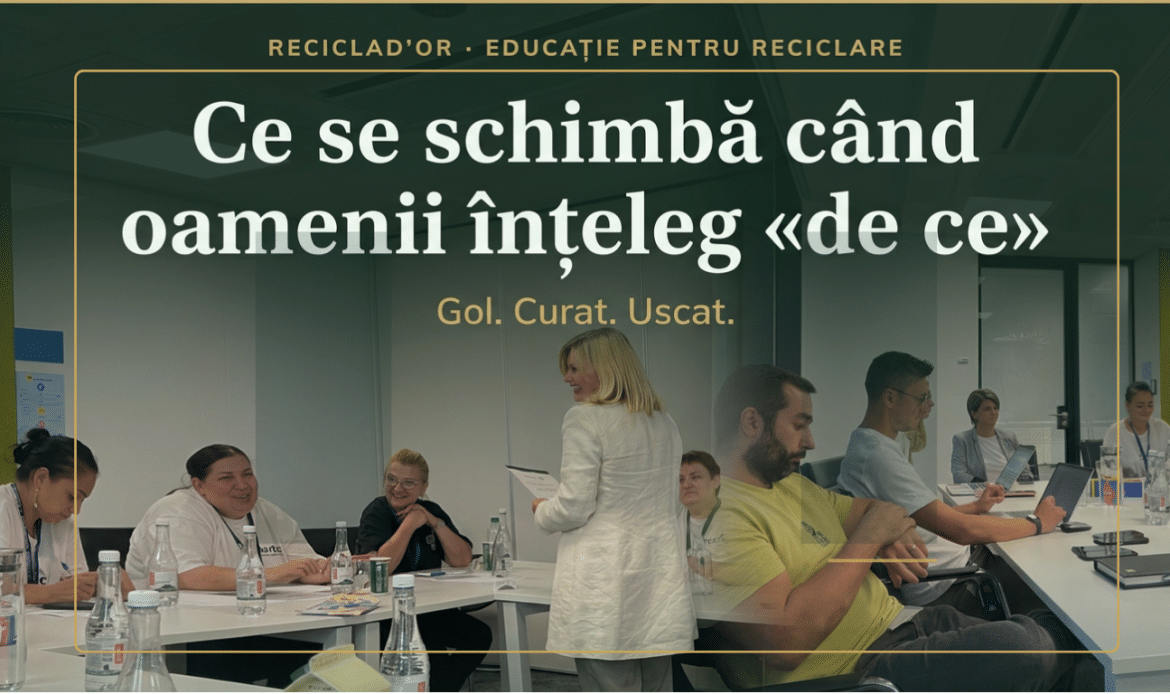
To change that, on September 18, we spent two hours with the technical staff working in the building of one of Reciclad’OR’s retail partners. A partner that understands the importance of sustainability and for whom employer branding is not simply another box to tick in a report, as demonstrated by the numerous awards it has received for its programmes promoting organisational culture.
It was a hands-on, interactive workshop, not simply a presentation. We asked questions, placed real objects on the table and gave participants the space to make mistakes, discuss and even disagree with one another, because it is precisely in those moments of disagreement that you can see where clarity is needed.
The question we started with about waste sorting
We began with a simple assumption, but one we rarely put to the test: people sort waste correctly when they understand what happens next to what they throw away, not simply when they are told where to put it.
A colour code on a bin answers the question “where?”. It never answers “why?”, and without the “why”, any rule tends to break down as soon as an exception arises.
So we showed them the actual loading and unloading form used between operators, demonstrating that every shipment is weighed, signed for and traceable. We placed objects on the table that people handle every day, such as a coffee cup, a Tetra Pak carton and an aluminium can, and asked them to decide, as part of a live exercise, where each item should go and explain their reasoning.
The discussions that followed were more valuable than any slide.
What actually changed
To make sure we were not left simply with the impression that the session “went well”, we measured the results: the same nine-question survey was completed anonymously before and after the workshop.
The average percentage of correct answers increased from 56% to 91%.
Beyond the figure itself, what impressed us most was what changed. Seven out of nine participants firmly believed that broken window glass belonged in the same category as glass packaging, the most widespread misconception in the group.
It is an understandable mistake. Visually, window glass and glass packaging may look very similar, but they have different melting points, and even a single piece mixed into the wrong stream can compromise an entire batch.
After the workshop, the percentage of correct answers to this question jumped from 22% to 88%.
But the moment that convinced us most strongly of the session’s impact came from an open-ended question:
“In your own words, what is the golden rule before putting packaging into the recycling bin?”
Before the workshop, not a single participant answered it correctly. Responses were either blank or vague, such as “it should be clean” or simply “sorting”.
Afterwards, everyone who completed the field wrote, almost identically, the same three words we had taught during the session:
Empty. Clean. Dry.
Three simple words, remembered by people who, until now, had never really been given a reason to remember them, because no one had explained them directly, face to face, in language that made sense to them.
Why we do this
As an EPR organisation authorised by the Ministry of Environment since 2017, managing packaging recycling obligations for more than 1,300 partner companies, at Reciclad’OR we build the procedures, reports and contracts that keep an entire system running.
But none of them matter if the person tying up the glass packaging bag has accidentally placed a piece of broken window glass inside it.
Extended Producer Responsibility is not measured only in tonnes reported. It is also measured in the moment when a person understands, for the first time, why their work matters.
For us, this workshop proved that this kind of investment can be seen in the numbers, not just in good intentions.
More importantly, it meant spending two hours listening to the people who actually make the difference.
That is how we truly understand what waste sorting means.
Reciclad’OR is the partner of companies that choose to treat environmental responsibility not as an obligation, but as a genuine competitive advantage.
Would you like to see what that could look like for your business? Contact us.