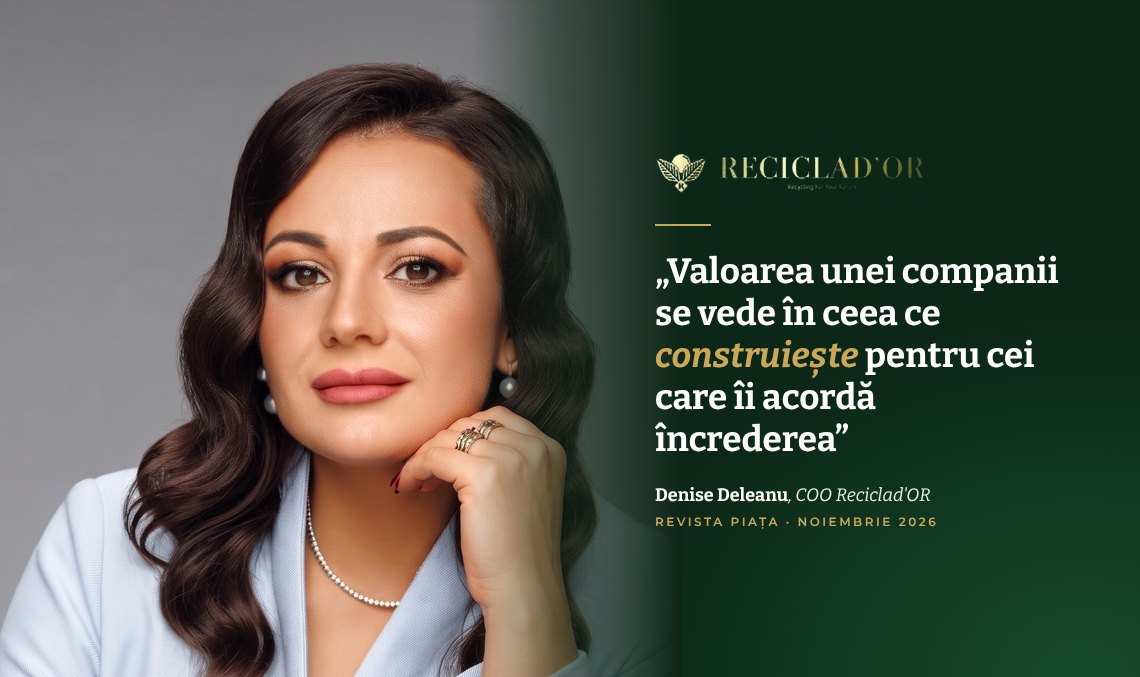
The new EU packaging rules are changing how companies design their products and plan their investments. Denise Deleanu, COO of Reciclad’OR, discussed this shift in an interview published in issue 242 of Piața Magazine (November 2026), in its Sustainability section.
Denise Deleanu: environmental responsibility is now a matter of strategy
The first point Denise Deleanu makes is also the most important one: environmental responsibility is no longer just an administrative obligation. It has become part of strategic decision-making. Companies want to understand what the new regulations mean for their costs, risks and opportunities.
For Reciclad’OR, 2026 marked nine years of activity, more than 1,300 partner companies and over two million tonnes of packaging waste managed since 2018. More than 50 workshops and webinars grew out of a simple conviction: accurate information, delivered at the right time, leads to better decisions.
PPWR reaches all the way to the production line
In FMCG, the PPWR will be felt most in packaging design and investment planning. One often underestimated factor is production infrastructure: a new material or a different packaging format may require bottling or packing lines to be adapted. That is why technical, procurement, finance, marketing and sustainability teams need to work together. Packaging is no longer just a product component. It is a competitiveness decision.
The real cost of PPWR compliance isn’t always the upfront one
A solution that looks cheap today can lead to equipment adaptation costs later on. There are real optimisation opportunities, such as using less material or more efficient transport. Still, not every sustainable alternative is automatically cheaper.
From expertise to practical tools
Companies don’t just need to know the legislation; they need to know how to apply it. That is where YVORA comes in: the app developed by CIRCULAD’OR with advisory support from Reciclad’OR. It translates PPWR requirements into each company’s day-to-day operations: packaging analysis, compliance documentation and access to specialist expertise.
Denise Deleanu: what makes the difference in the long run
Romania still has a significant gap to close against the EU target of recycling 70% of packaging waste by 2030. Closing it takes investment, legislative predictability and real collaboration across the entire chain: authorities, producers, retailers, collectors and recyclers.
Denise Deleanu’s conclusion: legislation and technology will change, but the principles of a sound business stay the same.
“The value of a partnership is measured not only by its cost, but by the benefits it creates over time.”
📄 Read the full interview (in Romanian) in the scan below.