
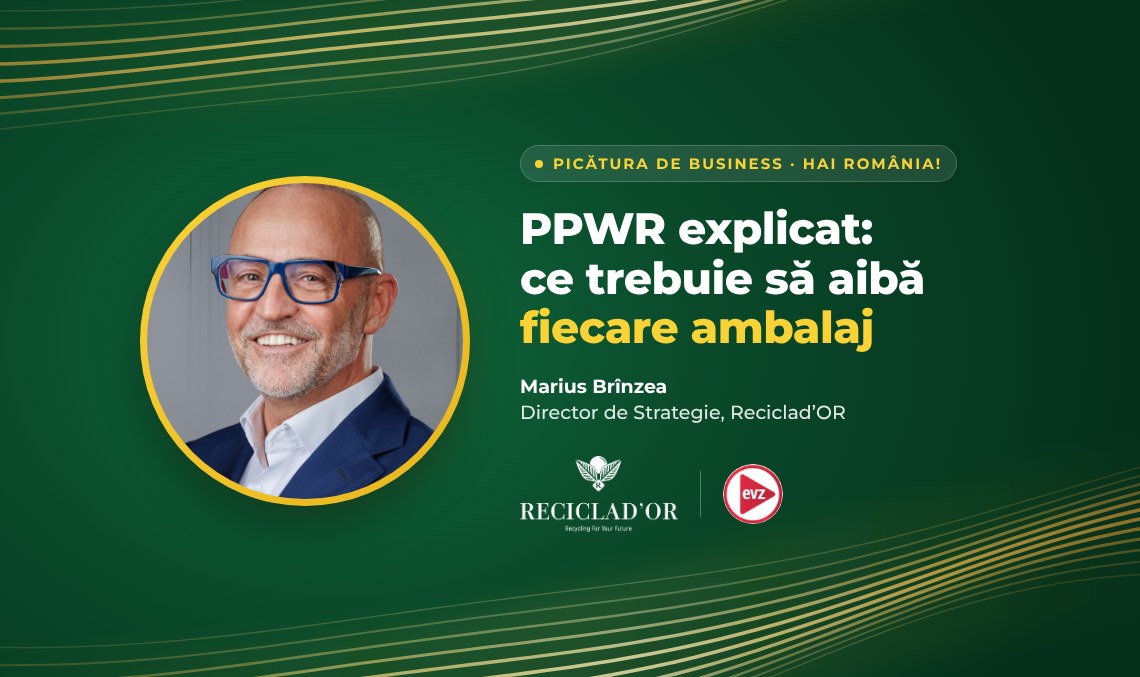
From 12 August 2026, Regulation (EU) 2025/40 on packaging and packaging waste (PPWR) applies directly in Romania. The first concrete obligation: every package placed on the market needs a compliance file, meaning technical documentation and a declaration of conformity.
On Picătura de Business with Radu Preda (HAI România! / EVZ), Marius Brînzea, Strategy Director at Reciclad’OR, explained what this means for manufacturers, importers, distributors and retailers, what companies risk if they fail to comply, and how to manage it all without it turning into a bureaucratic nightmare.
▶️ Full show: watch the interview on YouTube (in Romanian)
“12 August is not a ‘job done’ moment. It’s a process that will take 5–10 years, which means we are only at the beginning.”
Marius Brînzea
Key Takeaways
1. Every packaging code needs its own compliance file
The file has two parts: the technical documentation (Annex VII of the Regulation) and the EU declaration of conformity (Annex VIII), an eight-point document.
The volume varies enormously from one company to another. Some companies have around 50 packaging types, others easily exceed 1,000 codes. And the file is not a one-off: if you remove a label or reduce the packaging weight, you need a new version of the declaration for that package.
2. Step one: find out your role in the chain
PPWR assigns different roles, and a company can hold several of them at the same time:
- The manufacturer is the company whose brand appears on the packaging. It is the only one that issues the declaration of conformity, and there can be only one manufacturer per chain.
- The importer makes sure that packaged products brought into Romania have a declaration of conformity.
- The distributor has no obligations of its own regarding the declaration.
Marius’s example: a cold-cuts producer is the manufacturer for its own brand. For a retailer’s private label, however, the manufacturer is the retailer. The producer sends over the packaging sheet and the technical documentation, and the retailer issues the declaration and takes on the liability.
3. What goes into the technical documentation
- Packaging sheet: material, weights, components, packaging body, plus a photo and a drawing.
- Heavy metals test: mandatory for all packaging.
- PFAS test: also mandatory for packaging that comes into contact with food.
PFAS are the “forever chemicals”: compounds built on carbon–fluorine bonds that repel water and grease but do not break down in the environment. Tests are generally carried out in labs in Germany and Poland, and waiting lists are long. This is where many of the companies that still don’t have complete files have fallen behind.
4. The declaration goes to partners. The documentation goes to the authorities
When a partner such as a retailer asks for it, the company hands over the declaration of conformity, not the technical documentation. The documentation is checked by the inspection authority, which verifies whether the declaration is backed by evidence.
“We keep telling our partners: don’t put anything in the declaration that you can’t prove. You signed it, you stamped it, it’s on your own responsibility.”
Marius Brînzea
We showed what this looks like on real packaging at the PPWR workshop in Iași and at the working session at Antibiotice Iași.
5. The biggest risk isn’t the fine, it’s being pulled from the market
Member States must set the inspection methodology and penalties by February 2027. They can raise the Regulation’s targets, but they cannot lower them.
The pressure, however, is already coming from the market. Retailers warned their suppliers at the start of the year and are asking for declarations of conformity after 12 August.
“The biggest risk doesn’t come from the inspection methodology or the penalties. It’s simply being taken off the shelf.”
Marius Brînzea
6. Selling online: no authorised representative, no market access
Anyone selling through platforms such as eMAG, Amazon or Temu in another Member State must report their packaging and pay for its collection and recycling there, either directly or through an authorised representative. Marius gave a real example: since 12 August, Amazon has blocked sellers in Spain who did not have an authorised representative.
7. What comes next, through 2030
The declaration of conformity is the only certainty for 2026–2027. The other measures depend on guidelines and standards that are still in the works:
- Harmonised labelling, with identical pictograms on packaging and on collection bins, plus QR codes. The deadline was recently pushed back from 2028 to 2029.
- Bans on certain single-use plastic packaging (Annex V): mini shampoo portions in hotels, sugar sachets, and unprocessed fruit and vegetables under 1 kg packed in plastic.
- Recyclability grades A–D: A above 95%, B 80–95%, C 70–80%. Packaging below 70% can no longer be placed on the market from 2030. A multilayer plastic–aluminium blister, for example, may have a recyclability rate of only 30%.
- National targets: by 2030, Romania must cut the amount of packaging per capita by 5% compared to 2018.
“Companies aren’t looking at this regulation through the lens of 12 August 2026, but through the lens of rethinking their packaging portfolios.”
Marius Brînzea
Yvora: the PPWR app that automates the compliance file
How do you manage hundreds of packaging codes, declaration versions, 5- or 10-year archiving and documents in languages you don’t speak, all in Excel? That question is where Yvora (yvora.ro) started: the dedicated PPWR app developed by CIRCULAD’OR with advisory support from Reciclad’OR, launched on 28 July 2026.
What Yvora does:
- Identifies your company’s PPWR role (manufacturer, producer, importer, distributor) in two minutes.
- Builds the packaging sheet and automatically generates the declaration of conformity from the uploaded documentation, with completeness checks.
- Archives and versions all documents and automatically translates them into other languages.
- Provides a partner portal where retailers download the latest versions of the declarations themselves.
- Calculates the recyclability grade (A–D) based on validated international protocols and generates a strategic analysis for hard-to-recycle packaging.
Results so far: more than 150 companies are working in the app, and one of them already has complete files for over 900 codes. The time per file has dropped from 30–35 minutes to about 5 minutes, an 83% reduction. For a company with 1,000 packaging codes, costs fall by around 93%, which means savings of roughly €8,900.
What makes the difference is the human consultancy included in every subscription, delivered as live one-to-one sessions:
- Micro: up to 50 codes, 2 hours of consultancy, €196/year
- Starter: up to 500 codes, 8 hours of consultancy, €449/year
- Professional: over 1,000 codes, 12 hours of consultancy, €757/year
All subscriptions include 30 minutes of training. You can try the app free for 48 hours with the demo version.
PPWR: frequently asked questions
Who issues the declaration of conformity for packaging?
The manufacturer, meaning the company whose brand appears on the packaging. For private labels, the manufacturer is the retailer.
Which tests are required for the technical documentation?
The heavy metals test for all packaging, and the PFAS test for packaging that comes into contact with food.
When do PPWR penalties come in?
Member States must set the penalties and the inspection methodology by February 2027.
Do I need a new declaration if I change my packaging?
Yes. Any change, such as removing a label or reducing the weight, requires a new version of the declaration.
Get your compliance files ready
Reciclad’OR takes over extended producer responsibility obligations for more than 1,300 partner companies. For the PPWR documentation side, Yvora makes the compliance file fast, verifiable and easy to share with partners.
👉 Try Yvora free for 48 hours at yvora.ro, or write to us to talk to our team.
About Reciclad’OR
Reciclad’OR is a producer responsibility organisation (OIREP) authorised by the Romanian Ministry of Environment since 2017, managing packaging waste recycling obligations for more than 1,300 partner companies. Recycling for your future.
Source: “Picătura de Business” with Radu Preda, HAI România! / EVZ, 26 November 2026.